Learning Outline
Introduction to Anatomy & Physiology
Defining the subject
Human Biology – biological study of humans
- Biology is study of the nature of living organisms
Anatomy (“to cut apart”) – study of structure of organisms
- Dissection also means “to cut apart” and is the primary method of the anatomist
- Gross anatomy – structure of visible structures
- Microscopic anatomy – structure of invisible (too small to see) structures
Physiology (“words about nature”) – study of function of organisms

Medieval dissection. Note that the professor is in a chair while the dissector receives instruction.
Defining life
The approach offered in the textbook lists “characteristics of life”
- Responsiveness, conductivity, growth, respiration, digestion, absorption, secretion, excretion, circulation, reproduction (please do NOT memorize this list!)
- Unsatisfactory because it fails to define (it merely describes) and the list does not apply to all living beings
Self-organizing
- Seems to resist entropy (nature’s tendency toward disorder)
- This is the view taken by Lynn Margulis and Dorion Sagan in their book What Is Life?
- Autopoiesis (“self making”) refers to life’s continual making of itself by means of metabolism
- Metabolism — the inter-linked and ongoing chemical reactions of life; body chemistry
- Anabolism— metabolic reactions that make larger molecules out of smaller ones
- Catabolism — metabolic reactions that make smaller molecules out of larger ones
- Vladimir Vernadsky says that life is less a thing and more a process
-
Vernadsky said that living organisms are simply special forms of water
-
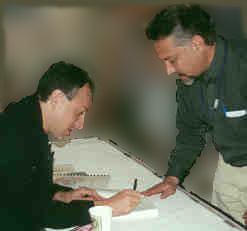
Dorion Sagan (coauthor of What Is Life? ) jots a few notes on the meaning of life
for Kevin Patton (right).
Here is an interesting perspective on what it means to be alive:
“. . . living organisms, including people, are merely tubes which put things in at one end and let them out at the other, which both keeps them doing it and in the long run wears them out. So to keep the farce going, the tubes find out ways of making new tubes, which also put things in at one end and let them out at the other. At the input end they even develop ganglia of nerves called brains, with eyes and ears, so that they can more easily scrounge around for things to swallow. As and when they get enough to eat, they use up their surplus energy by wiggling in complicated patterns, making all sorts of noises by blowing air in and out the input hole, and gathering together in groups to fight with other groups. In time, the tubes grow such an abundance of attached appliances that they are hardly recognizable as mere tubes, and they manage to do this in a staggering variety of forms. There is a vague rule not to eat tubes of your own form, but in general there is serious competition as to who is going to be the top type of tube. All this seems marvelously futile, and yet, when you begin to think about it, it begins to be more marvelous than futile.” —Alan Watts from The Book: On the Taboo Against Knowing Who You Are
 Required Superseded Scientific Theories
Analogies and models 
- Used frequently to explain or illustrate concepts
- Are simplified and are therefore incomplete
“The most exciting phrase to hear in science, the one that heralds new discoveries, is not ‘Eureka!’ (I found it!) but ‘That’s funny …’ “
—Isaac Asimov
History and culture
- Western and Eastern traditions
- Western tradition still uses Latin (also with Greek word parts) in terminology

If the video player above is blank (or not visible) click here

Homeostasis
Homeostasis = relative constancy of the internal (fluid) environment
- Examples: constancy of body temp (around 37°C), of blood pressure, blood glucose
Feedback
- Negative feedback – reverses the direction of change
- Positive feedback – amplifies the change (same direction)
Models
- Aquarium model, Engineering model, Wallenda model
Levels of homeostatic control
- Intracellular – regulation within a cell
- Intrinsic – regulation within a tissue or organ
- Extrinsic – regulation across systems and the whole body
Take note! Human body temperature varies!
|
Oral body temp
|
°F
|
°C
|
| Average temp |
98.2
|
36.8
|
| Upper limit of normal temp |
99.9
|
37.7
|
| Daily variability of temp |
0.9
|
0.5
|
Chaos
Chaos (as science concept) is “constrained randomness”
Human structure:
- Self-similarity (fractal geometry) and anatomy

Human function:
- Periodic body functions
- “periodic” means rhythmic (not chaotic)
- Example: heart voltage (EKG)
- Aperiodic body functions
- “aperiodic” means nonrhythmic (chaotic)
- Example: heart rate (HR; beats/min)
Change from chaotic to rhythmic OR change from rhythmic to chaotic
- May be associated with aging, disease, injury
Levels of Organization
Atoms
- Smallest unit of a pure substance (element) that still has properties of the substance
- Examples: H (hydrogen), O (oxygen), C (carbon)
Molecules
- Groups of atoms linked together
- Examples: H2O (water), CO2 (carbon dioxide), C6H12O6 (glucose)
Organelles
- “Tiny organs” made up of molecules that have certain functions; parts of a cell
- Examples: nucleus, mitochondrion, plasma membrane of cell
Cells
- Smallest unit of a living organism; made up of organelles
- The cell theory states that all living organisms are made of one or more cells
- Proposed by Schleiden & Schwann
- Also called the “cell doctrine”
- Examples: muscle cell, nerve cell, skin cell, blood cell
Tissues
- Group of similar cells together
- “Fabric” of the body
- Four groups of tissues in the human body:
- Epithelial
- Connective
- Nerve
- Muscular
Organs
- Discrete structures made up of more than one kind of tissue
- Examples: stomach, heart, lung, bone, skin
Systems
- Group of organs that function together
- Typical list of human body systems:
- Integumentary
- Skeletal
- Muscular
- Nervous
- Endocrine
- Digestive
- Respiratory
- Circulatory
- Lymphatic
- Urinary
- Reproductive
Organism
- Group of systems functioning together as a separate individual body
- Examples: human individual, tree, squirrel
Population
- Group of similar organisms living together
- Examples: human population, tree population, squirrel population
Community
- Group of interacting populations
- Examples: forest community (trees, squirrels, foxes), desert community (cacti, rattlesnakes, armadillos)
Ecosystem
- biotic (living) community and abiotic (nonliving) features
- Abiotic features include geology, climate, etc.
- Biotic features are the living organisms themselves (or their parts or activities)
- Examples: forest ecosystem, desert ecosystem
Biome
- All similar ecosystems on earth together
- Examples: the forest biome (all forests on earth), the desert biome (all deserts on earth)
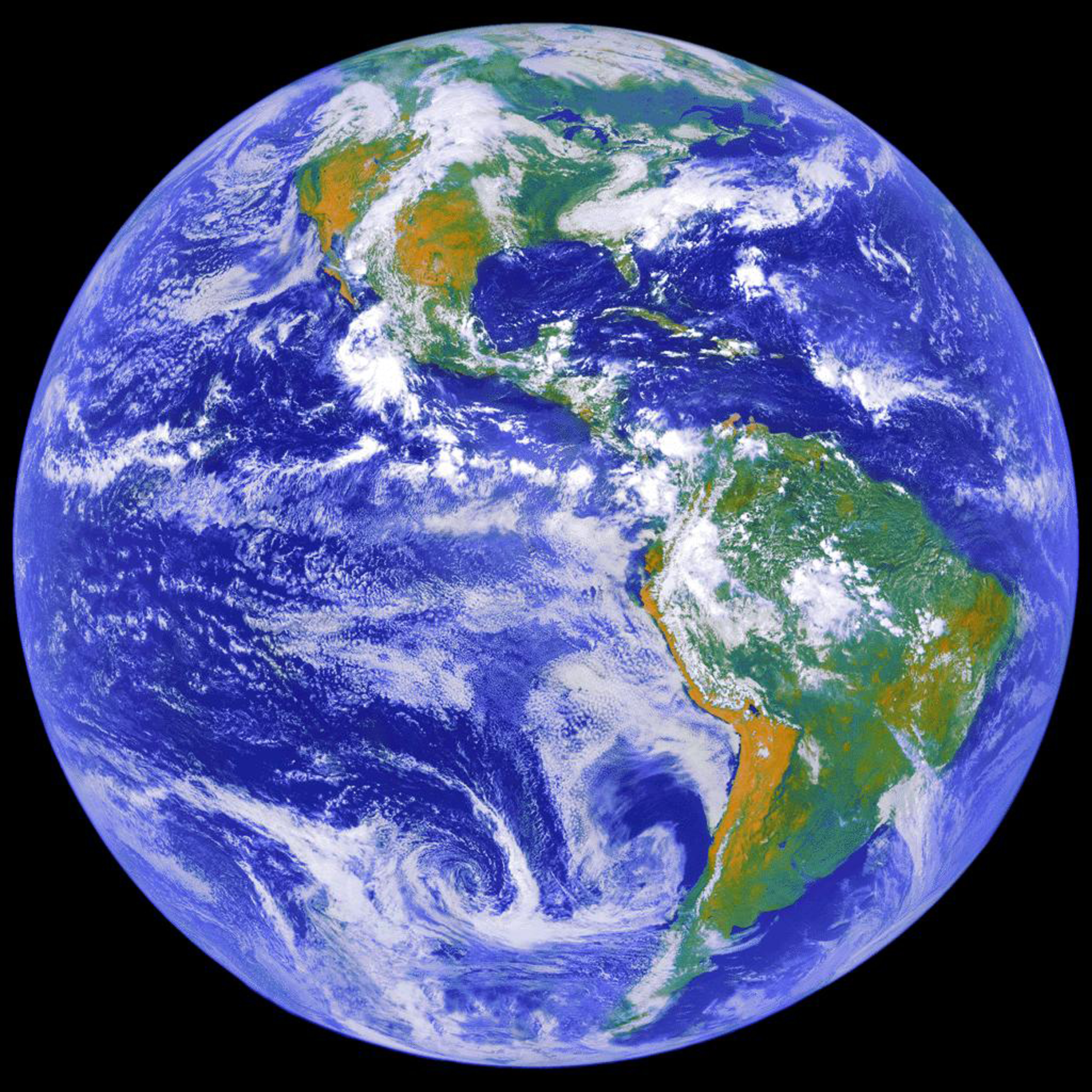
Biosphere (Gaia)
- The whole living layer around the globe (includes even abiotic features)
- Biosphere concept developed by the Russian, V. Vernadsky
- Gaia hypothesis
- Originated with James Lovelock; further developed by Lynn Margulis
- Looks at the earth as a giant living organism (Gaia, named for the ancient Greek goddess of the earth)
- Characterized by feedback mechanisms, as in an organism
- In their book What Is Life?, Margulis and Sagan (see above) stipulate that the whole biosphere is really one giant organism and each of us is really a collection of organs of the whole organism. What do YOU think?
- In his book (and film) An Inconvenient Truth Al Gore discusses global warming from the biosphere perspective. If you are familiar with the content, do you think he uses the concept in a scientifically appropriate sense?
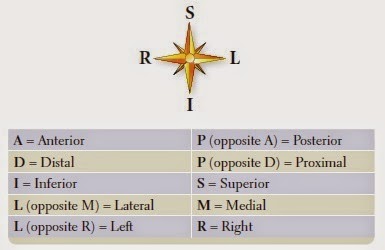
Body cavities, planes, and directions
These topics are covered in the Pre-A&P review outline Human Body
Hint #1: the inside front cover of your textbook has a handy reference
Hint #2: use the anatomical rosette (compass rose) to check directions on diagrams throughout the book

This is a Learning Outline page.
Did you notice the EXTRA menu bar at the top of each Learning Outline page with extra helps?
Readings, References, & Resources
A&P Core
Betts, J. G., DeSaix, P., Johnson, J. E., Korol, O., Kruse, D. H., Poe, B., Wise, J. A., Womble, M., & Young, K. A. (2013). Anatomy and physiology.
Khan Academy. (n.d.). https://www.khanacademy.org/science/health-and-medicine
Patton, K. T. (2013). Survival Guide for Anatomy & Physiology. Elsevier Health Sciences.
Patton, K. T., Bell, F. B., Thompson, T., & Williamson, P. L. (2022). Anatomy & Physiology with Brief Atlas of the Human Body and Quick Guide to the Language of Science and Medicine. Elsevier Health Sciences.
Patton, K. T., Bell, F. B., Thompson, T., & Williamson, P. L. (2023). The Human Body in Health & Disease. Elsevier Health Sciences.
Patton, K. T., Bell, F. B., Thompson, T., & Williamson, P. L. (2024). Structure & Function of the Body. Elsevier Health Sciences.
Topic Focused
Coming soon!
Last updated: February 16, 2025 at 17:15 pm