Learning Outline
Tissues and Membranes of the BodyA&P 1
We’re covering ONLY the membranes of the body for now—specific tissue types are covered elsewhere.
For more information:
Introduction to Tissues
Tissues Organs Systems
Membranes
Epithelial membranes
- Epithelial membranes have two layers: epithelial and connective (joined by a gluelike basement membrane)

Serous membranes
- Line cavities that are not open to the external environment
- Examples
- peritoneum (lines abdominal cavity/covers abdominal organs)

- pleura (lines pleural cavity/covers lung)
- peritoneum (lines abdominal cavity/covers abdominal organs)
- Examples
- Usually two layers, formed when one layer folds back on itself to form double layer
- Visceral layer: the layer against the internal organs (organs=viscera)
- Parietal layer: the layer against the inside wall of the cavity
- There is a potential space between the parietal and visceral layers with a small amount of serous fluid
- Serous fluid is watery fluid that lubricates and holds layers together (cohesive)
- A potential space is like my pocket: there’s room for a lot of money but it’s usually empty, with both layers of material touching one another and no significant space is between them
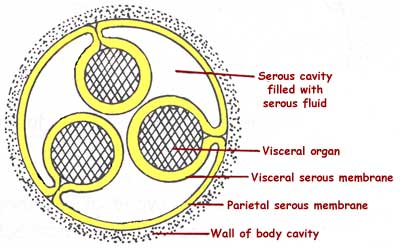
Serous membranes.
Ordinarily they have two layers: visceral & parietal
Mucous membranes
- Line cavities that are open to the external environment
- Examples
- Lining of mouth, digestive tract, reproductive tract, urinary tract, respiratory tract
- Examples
- Single layer
- Mucus (noun) refer to a fluid; mucous (adjective) describes something that has mucus on it or is otherwise associated with mucus
- Mucus is a watery secretion that varies in consistency, depending on its function
- Sometimes watery, as mucus produced by the nose’s lining in an allergy
- Sometimes sticky, as mucus that normally lines the nose (snot)
- Sometimes lubricating, as mucus in digestive tract or vagina
- Sometimes protective, as mucus that protects the stomach’s lining from acid and enzymes
|
Cervical mucus. During fertile phases, the mucus produced in the neck (cervix) of the womb (uterus) changes to a more fluid, elastic consistency (shown) to enable sperm to pass through, toward an egg (ovum). Between fertile periods, the mucus here becomes thick, preventing both sperm and potentially harmful microbes from entering. |

Cutaneous membrane (another name for “skin”)
- Cover surfaces exposed directly to the external environment
- Produces several fluids: sweat, oil, etc.
Cutaneous membrane (another name for “skin”)
- Cover surfaces exposed directly to the external environment
- Produces several fluids: sweat, oil, etc.
Connective tissue membranes
- Connective tissue membranes have more than one layer, all connective tissue types
Synovial membranes
- Line joint cavities
- Movable joints are therefore called synovial joints
- Synovial fluid lubricates and cushions joints
Last updated: October 22, 2019 at 13:36 pm