Learning Outline
Mini Lesson: Chaos
Chaos and the Human Body
Introduction to scientific chaos
Chaos (as science concept) is “constrained randomness”
- In ordinary conversation “chaos” usually means “total randomness” or “unpredictability”
- However, in math and science “chaos” means something that LOOKS random or unpredictable but IN REALITY has an underlying order or pattern to it
“Chaos theory” began in 1960, with experiments by (American) Edward Norton Lorenz

Edward Lorenz
1917-2008
Founder of chaos science
- Lorenz was a meteorologist at MITwho used only a dozen simple equations in a computer to model a very complex, natural-acting weather system. This led to many discoveries across science that many “unpredictable” aspects of nature really do have underlying mathematical principles.
The best introductory book on chaos is Chaos: Making a New Science by James Gleick
” Where chaos begins, classical science stops. For as long as the world has had physicists inquiring into the laws of nature, it has suffered a special ignorance about disorder in the atmosphere, in the turbulent sea, in the fluctuations of wildlife populations, in the oscillations of the heart and the brain. The irregular side of nature, the discontinuous and erratic side–these have been puzzles to science, or worse, monstrosities.
But in the 1970s a few scientists in the United States and Europe began to find a way through disorder. They were mathematicians, physicists, biologists, chemists, all seeking connections between different kinds of irregularity. Physiologists found a surprising order in the chaos that develops in the human heart, the prime cause of sudden, unexplained death. Ecologists explored the rise and fall of gypsy moth populations. Economists dug out old stock price data and tried a new kind of analysis. The insights that emerged led directly into the natural world–the shapes of clouds, the paths of lightning, the microscopic intertwining of blood vessels, the galactic clustering of stars.” —James Gleick
Human function
Periodic (rhythmic; not chaotic) body functions
- Examples of human functions that vary rhythmically when healthy
- female reproductive cycle
- sleep cycle
Aperiodic (nonrhythmic; chaotic) body functions
- Examples of human functions that vary nonrhythmically
- heart rate (HR; beats/min) (NOTE: this is NOT the same as EKG!!)
- gait (walking pattern)
Change from chaotic to rhythmic OR change from rhythmic to chaotic
- May be associated with aging, disease, injury
- Heart rate (HR) example
- When healthy, the HR fluctuates nonrhythmically
- That is, the HR goes up and down, but relatively unpredictably –you don’t know exactly what your HR will be in the next moment (even though you may know about what it will be)
- In aging, injury, and disease the HR may begin to fluctuate more predictably, going up and down in a clear, rhythmic pattern
- OPTIONAL: for a brief report click here or for a brief audio story click here
- In this example, chaotic function is normal and periodic function is abnormal
- When healthy, the HR fluctuates nonrhythmically
- Brain wave example
- Brain waves (EEG) fluctuate chaotically (nonrhythmically) when healthy, even at different levels of consciousness
- See Chapter 13 for examples of brain waves (EEG)
- In a seizure, brain waves begin to become more rhythmic, less chaotic
- In this example, chaotic function is normal and periodic function is abnormal
- Brain waves (EEG) fluctuate chaotically (nonrhythmically) when healthy, even at different levels of consciousness

Time ——————->
A The above an example of chaotic function. It is relatively aperiodic (without a clear rhythm).
Normal heart rate (plotted in beats/min across time) should look sort of like this.

Time ——————->
B The above is an example of periodic function. It is relatively rhythmic.
A person with a heart rate (beats/min) that plots out like this is in SERIOUS trouble.
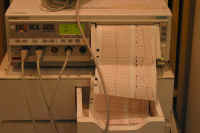
Fetal heartrate monitor
The machine shown in the photograph above is used during labor and delivery and plots the heart rate of the newborn (on the left side of the graph paper) and plots the relative strength of uterine (labor) contraction (on the right side of the graph). Click on the photo to enlarge it.
Notice that the baby’s HR is a chaotic function (which is normal) and the mother’s uterine contractions are somewhat rhythmic (which is normal).
Human structure
Fractal geometry is an aspect of chaos
- Fractal geometry is capable of producing highly complex patterns with elements of unpredictability by using very simple mathematical expressions
Self-similarity is a characteristic of fractal geometry
- Self-similarity means that the pattern of each small part of a structure resembles the pattern of the overall structure
- An example in nature is found in trees: a pine branch resembles a whole pine tree, whereas an oak branch resembles a whole oak tree

- Other examples in nature of self-similar structures
- coastlines
- plants
- frost and snowflakes
- mineral crystal formations
- course of rivers and streams
- An example in nature is found in trees: a pine branch resembles a whole pine tree, whereas an oak branch resembles a whole oak tree
- Another way to see self-similarity:
- Fractal surfaces have bumps, each of the bumps have their own bumps, those bumps have bumps, and so on —nearly infinitely, perhaps
- Each of the tiniest bumps in such a system “kinda looks like” any of the largest of the bumps in the same system
- Fractal lines have branches, each branch has branches, each of those branches have branches, and so on
- Each of the tiniest branches in such a system “kinda looks like” any of the largest of the branches in the same system
- Fractal surfaces have bumps, each of the bumps have their own bumps, those bumps have bumps, and so on —nearly infinitely, perhaps

Many human structures are self-similar, and therefore are chaotic (at least to some extent)
- Example of structures in the human body that are self-similar
- Digestive tract (intestines, for instance)
- Blood vessels (see Fractal Body – required)
- Respiratory tract
- Nerve pathways
- Self-similarity means that MANY bumps or branches can fit into a small space
- This makes absorptive surfaces, as the surfaces in the digestive tract that absorb nutrients, MORE absorptive than if they were smooth
- This makes the blood vessels capable of carrying more blood to more places than if it wasn’t so highly branched
- Thus, chaos improves function by improving structure in the body
Human structures are complex but are built using only a relatively few genes
- Remember, very complex fractal (chaotic) forms can be be produced with very simple math expressions
- Thus genetic information may be simple, but it can produce complex structure and functions by using chaotic approach

Human airways.
The branching of the lower respiratory tract is an example of fractal-like anatomy—branches have branches have branches . . .
 Optional: If you want an entertaining and easy-to-follow explanation of fractals (including fractals in the human body), watch this PBS video NOVA: Hunting the Hidden Dimension about
The bottom line
What you have to know about chaos for your course
- You have to know what the term chaos (scientific sense) means in general
- You have to know that some body functions are normally chaotic (and if they become more rhythmic, that’s trouble) and examples
- You have to know that many body structures are chaotic, exhibiting self-similarity, which increases their size/complexity (and thus increases the amount/complexity of their functions) —and know examples
If you are really interested in chaos, another good book is If you want an entertaining and easy-to-follow explanation of fractals (including fractals in the human body), watch this PBS video Deep Simplicity: Bringing Order to Chaos and Complexity about
This is a Learning Outline page.
Did you notice the EXTRA menu bar at the top of each Learning Outline page with extra helps?
Last updated: October 22, 2019 at 12:27 pm