Learning Outline
HomeostasisMini Lesson
The body’s balance
Introduction to homeostasis
homeo = same; stasis = standing
Homeostasis = relative constancy of the internal fluid environment 

The concept was first articulated by [Frenchman] Claude Bernard in 1860s

Claude Bernard (1813-1877)
The term “homeostasis” was first used by [American] Walter Bradford Cannon in 1920s
Cannon was the one who really established homeostasis as a unifying concept of human physiology

Walter B. Cannon (1871-1945)
Fishbowl model
Fish are like the cells of the [multicellular] body
Internal environment of the fishbowl is a fluid that must be maintained in relatively constant conditions for the fish to survive in health
- Optimum temperature, high nutrient level, high oxygen level, low carbon dioxide level, low nitrogen-waste level, optimum pressure, etc.
- Devices such as heaters/chillers, auto feeders, aerators, filters keep conditions relatively constant
In the human body, physiological mechanisms keep oxygen up and carbon dioxide down (respiratory system), nutrients up (digestive system), wastes low (kidneys), temperature constant (muscles, sweat, etc)

Fishbowl Model
| Fishbowl | Human Body |
Function |
|
Water |
Body fluid |
Internal environment |
|
Glass bowl |
Skin |
Barrier (internal vs. external) |
|
Fish |
Cells |
Stay alive |
|
Air pump |
Lungs |
Keep O2 level constant (high) |
|
Filter |
Kidneys |
Keep nitrogen wastes constant (low) |
|
Heater |
Muscles |
Keep temperature constant (high) |
|
Feeder |
Digestive system |
Keep nutrient levels constant (high) |
|
Everything working together |
Relatively constant conditions |
|
Engineered control system (thermostat) model
Example: thermostatic heating system in a home
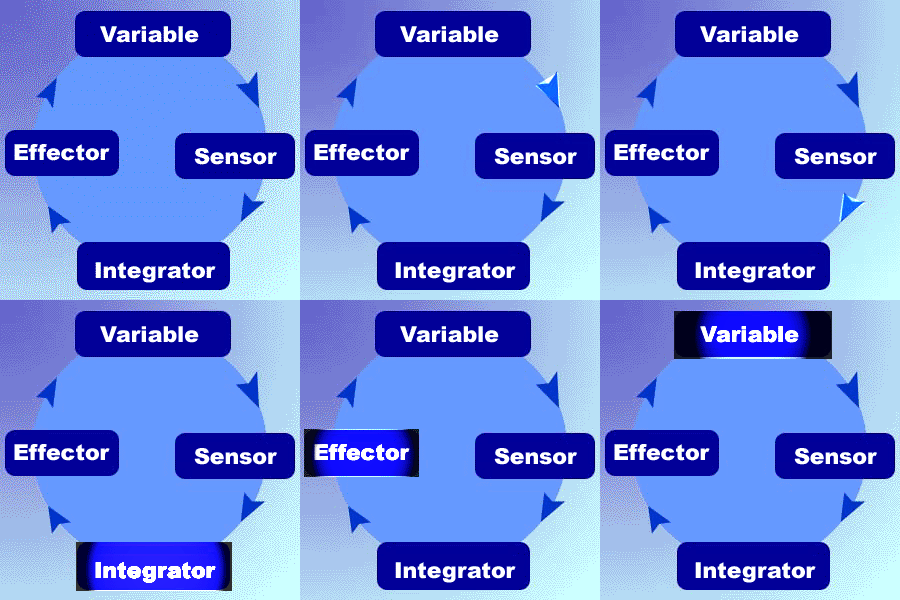
Components of an automatic control system
- Variable is the characteristic of the internal environment that is controlled by this mechanism (internal temp in this example)
- Sensor (receptor) detects changes in variable and feeds that information back to the integrator (control center) (thermometer in this example)
- Integrator (control center) integrates (puts together) data from sensor and stored “setpoint” data (thermostat in this example)
- Setpoint is the “ideal” or “normal” value of the variable that is previously “set” or “stored” in memory
- Effector is the mechanism (furnace in this example) that has an “effect” on the variable (internal temperature in this example)
Changes in temp are detected by thermometer, which feeds info about the actual temp back to thermostat, which has been previously set to ideal (setpoint) value; thermostat compares actual value to setpoint value and sends signal to furnace, which fires up and changes the internal temp back toward setpoint (furnace will shut down when thermostat determines actual temp is now higher than setpoint temp)
Negative feedback
- Occurs when feedback (from sensor to integrator) results in a reversal of the direction of change
- In example, thermostat’s response causes temperature decrease to reverse and become a temperature increase
- Negative feedback tends to stabilize a system, correcting deviations from the setpoint
- Human example: shivering in response to cooling of body during cold weather
Positive feedback
- Occurs when feedback (from sensor to integrator) results in an amplification of the change (same direction as deviation from setpoint)
- In example, positive feedback would occur if the thermostat’s response to a dropping temperature was to switch off the furnace or to switch on the air conditioner (chiller)
- Another example: audio “feedback” occurs when amplified sound is picked up by microphone and then amplified again then picked up and amplified again, and again, and again –each time getting louder
- Can be stopped only if “feedback loop” is broken
- Human example: increased labor contractions stimulated by oxytocin (OT) hormone
 Fetus’s head moves into birth canal (vagina) at start of labor, which causes the birth canal to stretch beyond its setpoint amount of stretch, which is detected by sensors (stretch receptors) in the vaginal wall and fed back to hypothalamus of brain, which releases OT, which stimulates stronger and more frequent uterine (womb) contractions, which pushes the fetus, which causes more vaginal stretch, which produces more OT, and so on –greatly amplifying and speeding up labor contractions
- Broken when baby is born (no more stretch, thank goodness)
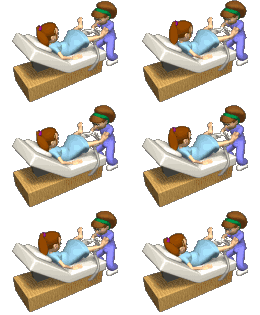 Fetus’s head moves into birth canal (vagina) at start of labor, which causes the birth canal to stretch beyond its setpoint amount of stretch, which is detected by sensors (stretch receptors) in the vaginal wall and fed back to hypothalamus of brain, which releases OT, which stimulates stronger and more frequent uterine (womb) contractions, which pushes the fetus, which causes more vaginal stretch, which produces more OT, and so on –greatly amplifying and speeding up labor contractions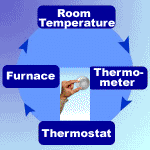
Click to enlarge |
 |
Click to enlarge |
|
Engineered Room Control |
Feedback Loop |
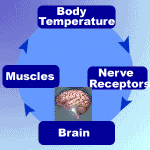
Human Body Thermoregulation |
| Room Temperature | Variable The characteristic that is controlled |
Body temperature |
| Thermometer | Sensor Detects the value of the variable |
Nerve receptors |
| Thermostat | Integrator Compares the actual value of the variable to a pre-determined setpoint value |
Brain (hypothalamus) |
| Furnace | Effector Instrument that has an effect on (changes) the variable |
Muscles (shivering) |
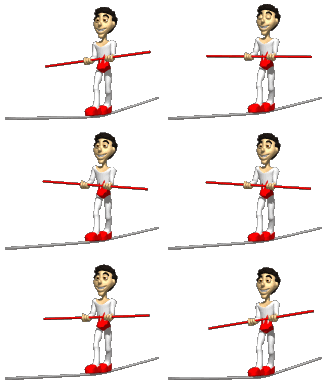
Wallenda model
The Flying Wallendas are a family of circus performers famous for their high-wire acts (this model is that of a high-wire artist)
Karl Wallenda (former patriarch of the family acts) made “sky walks” famous
- Single artist walking across single wire (very high, very long –as in old Busch Stadium walk)
- Click here to see current family patriarch, Tino, doing these daring skywalks
- Uses negative feedback to maintain relatively constant position on wire (setpoint is having wire walker’s center of gravity directly over wire)
- Karl died in a skywalk in Puerto Rico when, sadly, he couldn’t maintain a constant position over the wire
- That’s how we all die—we each eventually lose homeostatic constancy (but hopefully ours won’t be shown on the news)
|
Elements of the |
|
Variable: position of body Setpoint: directly over the wire Sensors: nerve receptors (eyes, inner ears, muscle stretch receptors, etc.) Integrator: brain Effectors: skeletal muscles
|
Seven-person pyramid – famous Wallenda trick involved multiple balances to maintain pyramid of 7 artists
- Fell in 1962 when front artist lost grip on balance pole, all 7 lost their balance
- Two died in accident, one permanently paralyzed from waist down, all were injured
- Recreated by Wallendas in late 1990s (premiering at Detroit, then Forest Park in St. Louis’s Circus Flora) . . . and then in 2001, they achieved a 10-person pyramid
- Click here to see photos of how the pyramid is arranged and a video clip of the “7” in action
- Wallenda model illustrates these concepts of homeostasis

- Negative feedback maintenance of variable
- Homeostasis is a dynamic, energy-consuming process
- Homeostatic balance is vital to healthy survival (you die when you lose it)
- Balance of one homeostatic variable is often interdependent with the balance of other variables

For more on the Wallenda model of homeostasis see
Survival Guide for Anatomy & Physiology
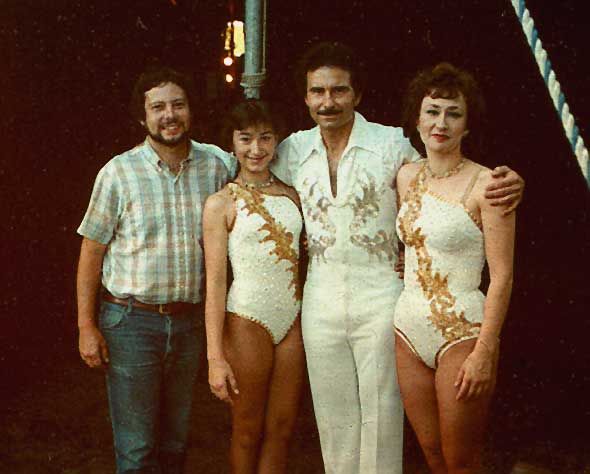
Kevin (left) with The Flying Wallendas (Alida, Tino, Olinka) when they all performed on the same program in Circus Flora at Faust Park in 1987.
Click image to enlarge it
Readings, References, & Resources
A&P Core
Betts, J. G., DeSaix, P., Johnson, J. E., Korol, O., Kruse, D. H., Poe, B., Wise, J. A., Womble, M., & Young, K. A. (2013). Anatomy and physiology.
Khan Academy. (n.d.). https://www.khanacademy.org/science/health-and-medicine
Patton, K. T. (2013). Survival Guide for Anatomy & Physiology. Elsevier Health Sciences.
Patton, K. T., Bell, F. B., Thompson, T., & Williamson, P. L. (2022). Anatomy & Physiology with Brief Atlas of the Human Body and Quick Guide to the Language of Science and Medicine. Elsevier Health Sciences.
Patton, K. T., Bell, F. B., Thompson, T., & Williamson, P. L. (2023). The Human Body in Health & Disease. Elsevier Health Sciences.
Patton, K. T., Bell, F. B., Thompson, T., & Williamson, P. L. (2024). Structure & Function of the Body. Elsevier Health Sciences.
Topic Focused
Coming soon!
Last updated: February 16, 2025 at 17:18 pm