Learning Outline
Mini Lesson:Serial Endosymbiosis Theory (SET)
and Human Cellular Organelles
Introduction to SET
Definition
- SET = serial endosymbiosis theory
- Serial = in a series: one step follows the next
- endosymbiosis = concept in biology in which one or more organisms lives inside another organism
- Theory = a scientific idea that has a fairly high level of confidence, based on observation and experimentation
- In a nutshell, SET is the notion that complex living cells result from evolutionary processes in which earlier cells merge in a series of successive combinations to eventually form larger, more complex cells
History
- Although some of the ideas of SET surfaced in the early 20th century, Lynn Margulis was the first to articulate a well developed theory in a 1967 journal article and then more completely in 1981 in her book Symbiosis in Cell Evolution
 .
.
- See the quote from Margulis below
- Although not accepted by most scientists at first, mounting experimental evidence has led to an almost universal acceptance of many elements of SET
- This theory is still a “working model” and continues to be refined by Margulis and others
- There are alternative hypotheses that have been proposed as well
 .
.
 Lynn Margulis (originator of SET) and Kevin Patton (right) ponder the meaning of life (click for larger image)
SET and Human Anatomy & Physiology
SET and human cells
- To [over]simplify, SET suggests that each human cell can be thought of as a merging of several earlier cell types and that some organelles were in fact at one time separate bacterial cells

Mitochondrion.
The highly folded cristae (folds) inside this ovoid organelle contain enzymes that facilitate the “recharging” of ATP
- Of particular interest in our course is the mitochondrion
- According to SET, the mitochondria now in our cells were once bacteria that were capable of energy conversions (cellular respiration) different from, but complementary to, the energy pathways of the original host cells
- The mitochondria have a protected environment with plenty of surplus glucose from the [host] cell available to “recharge” ATP
- The [host] cell can use the surplus ATP from the mitochondrion to run a larger, more complex cellular system
- Other organelles such as cilia and flagella may have once been independent organisms, as well
Implications and applications
If mitochondria were once independent bacteria, one would expect bacterial structures and functions
They do.
- For example
- Highly folded internal membranes
- A bacterial genome (in the form of a single DNA strand looped into a ring shape)
- Self-replicating (at least within the cell) in a manner similar to bacteria
- Metabolic processes similar to some bacteria
The “mitochondrial genome”
- DNA strand in the molecule is called mitochondrial DNA (mDNA or mtDNA)
- A ring, as in bacteria, not a folded string as in the nucleus

- A ring, as in bacteria, not a folded string as in the nucleus
- All mitochondria of a cell seem to be genetically identical, as are all bacteria of the same colony
- Mitochondria are “descended from” the mitochondria in the mother’s egg cell (sperm mitochondria, if any enter the egg during fertilization, must all “die off”)
- This implies that all the mtDNA in your cells is identical to that in your mother and any other relative related “maternally” to you (including all your children, if you are female) but not identical to the mtDNA of your father or “paternal relatives” (or your children, if you are male)
- Since there is far less variation in mtDNA than in nuclear DNA from generation to generation, scientists have used mtDNA to discover relationships between different populations of humans with greater accuracy

Mitochondrial function, in light of SET, can be viewed as “subcontracting” in some ways
- Mitochondria “perform a service” for the cell (transfers energy from glucose [acetyl] to ATP)
- The cell “pays” the mitochondria with glucose for its own use (“room and board”)
- When the subcontractor (mitochondria) have malfunctioning enzymes, either through direct damage or genetic mutation of mtDNA, then the whole cell may suffer because the subcontractor isn’t doing its contracted services properly
- For example, certain mtDNA mutations can be involved in Parkinson Disease, Alzheimer Disease, certain forms of blindness, and other inherited conditions
- Why would these diseases of mitochondrial origin be passed by the mother but not the father? Might male children of affected women also be affected –or just the female children?

mtDNA and disease
This ringlike diagram of mitochondrial DNA shows the locations of a few of the mutations known to cause human disease (click on the image for a larger view and source/attribution)
In both her writings and in person, Lynn Margulis has entertained the notion that SET plays into the concept that we are all [organisms] “part of each other” and that perhaps the very idea of an “independent organism” is false because we are all made up of smaller organisms and interact with with other organisms to form an even larger “organism.”
- What does this statement mean? How does it extend or apply SET?
- How does this fit in with the Gaia hypothesis (mentioned when we studied “levels of organization” in the course introduction A&P 1)
 |

TIME
|
|
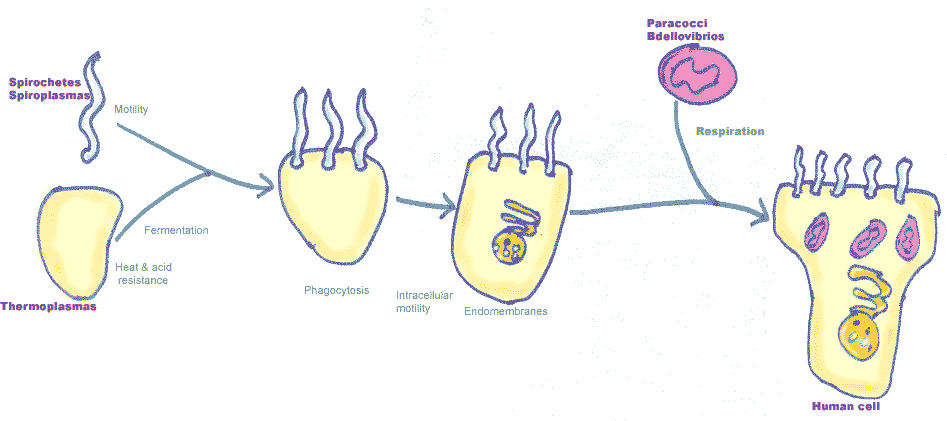
Click the image to enlarge it Serial Endosymbiosis Theory (applied to human cells)This diagram shows that early bacteria may have merged over time to form cells of greater complexity, including human cells. Successive mergers (secondary endosymbiosis) added structural and functional features, such as new organelles, to the resulting cells. These “enhanced” cells then include organelles that were once separate organisms. Notice the proposed mechanism by which a human cell may have inherited cilia (blue) and mitochondria (pink). This diagram is adapted from Lynn Margulis in Symbiotic Planet. This figure is incomplete, but it gives a very rough idea of how SET applies to human cells and their organelles. See also the animated slide version. |

In the words of Lynn Margulis
 “Not until I was well into my second marriage and pregnant with my daughter Jennifer (in 1969) was I obliged to stay home for extended periods. Enforced home leave permitted uninterrupted thought. This, in turn, stimulated me to document the expanded version of my four-part SET narrative clearly. The story of the origin of cells begun in my 1967 paper sprouted, expanded, and eventually was pruned into a book-length manuscript. I typed late into many nights, determined to make the deadline required by contract. Of course, as a virtual unknown I was given neither advance nor compensation for the many illustrations I commissioned. All help came from home. Finally I completed what I thought was the final draft…I boxed up and then mailed off the heavily illustrated work to the publisher who held the contract: Academic Press in New York City. The receipt of the box was not acknowledged. I waited. I continued to wait, for about five months. One day my box, without explanation, sent by surface book rate, reappeared at my mailbox. Much later I was informed, not even by the editor, that extremely negative peer review had led Academic Press to hold the manuscript for months. From the press finally I received a letter of rejection. No explanation, in fact not even a personal letter signed by the Academic Press editor, accompanied the formal rejection. More than a year later,…the book finally was nicely edited, produced, and published by Yale University Press. Because of commentary and criticism from Max Taylor and other generous colleagues the serial endosymbiosis theory prevailed. Eventually the pain of the Academic Press rejection subsided.
SET attracted experimental contributions by many scientists and graduate students unknown to me throughout the 1970s and 1980s. Molecular biological, genetic, and high-powered microscopic studies all tended to confirm the once radical nineteenth-century idea that the cells of plants and of our animal bodies (as well as those of fungi and all other organisms composed of cells with nuclei) originated through a specific sequence of mergers of different types of bacteria. Joint residence prevails and proliferates. My most current version of SET is shown in figure 2*. Today I am amazed to see a watered-down version of SET taught as revealed truth in high school and college texts. I find, to my dismay if not to my surprise, that the exposition is dogmatic, misleading, not logically argued, and often frankly incorrect. Unlike the science itself, SET is now uncritically accepted. So it goes.”
—Lynn Margulis in Symbiotic Planet
*Refers to Figure 2 in Symbiotic Planet. An expanded and detailed version of the diagram that appears above. Click here for an even more complicated figure.
Some questions to ponder
In the passage above, what situation caused Margulis to stay home and work out details of her SET concepts?
Was Margulis’s book about SET accepted for publication eagerly?
When does Margulis say that the ideas that led to SET first appear?
Why should Margulis fret over SET’s uncritical acceptance today?
Related information
Here are a few links to expanded or more detailed discussions of SET, including expanded or alternative theories (not required)
This is a Learning Outline page.
Did you notice the EXTRA menu bar at the top of each Learning Outline page with extra helps?
Last updated: October 22, 2019 at 13:48 pm