Learning Outline
Introduction to CellsPre-A&P
The generalized cell
Human cells are eukaryotic cells (that is, complex cells with a nucleus)
Plasma membrane
Cytoplasm – cell stuff 
- Cytosol – cell solutions
- Organelles – cell structures
- Membranous and nonmembranous
Nucleus
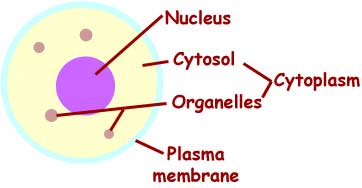
The “main” parts of a typical cell.
Cellular membranes 
Membranes of the cell
Plasma membrane – outer boundary of cell
Organelle membranes form boundaries around and within many organelles
All these membranes are cell membranes
Fluid mosaic model
- Phospholipid bilayer with imbedded proteins and hybrid molecules

- Cholesterol (among phospholipid tails) stabilizes membrane
- Rafts
- Linked groups of membrane molecules that travel together like a raft within the fluid bilayer
- Linked groups of membrane molecules that travel together like a raft within the fluid bilayer


Membrane functions
See table in textbook Chapter 3 
Cell membrane functions are cell functions (that is, many functions of cells that we will discuss are in reality jobs performed by the membranes of cells)
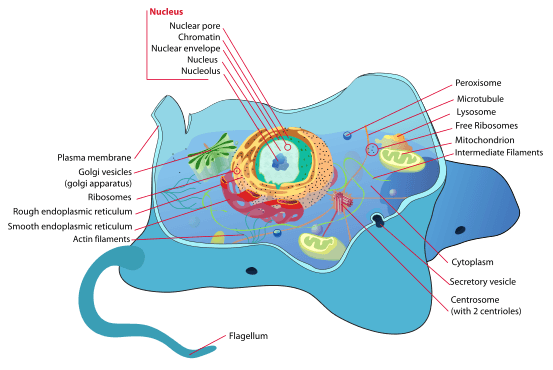
A “typical” cell model.
Click here for a larger image.
Campare to another cell model.
Other cell structures
cell structures
Most cell structures are called organelles
We’ll review only the main types of cell structures (there are MANY others, with more being discovered all the time)
Nucleus
Nuclear envelope
- Nuclear pores
- Nuclear pore complex (NPC) is the specific structure at each opening in the nuclear envelope
- Chromation
- DNA plus protein
- Chromosome = condensed chromatin
- Primary genetic code of the cell
- Click here

- Nucleolus – forms ribosome parts (rRNA)
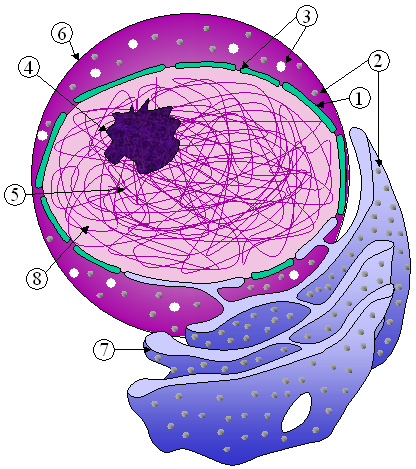
Nucleus and ER
| 1. nuclear envelope | 5. chromatin (DNA) strands |
| 2. ribosomes | 6. nucleus |
| 3. nuclear pores | 7. Rough ER |
| 4. nucleolus | 8. nucleoplasm |
Mitochondrion
Plural is mitochondria
Double membrane – inner membrane folded into cristae
- Interior is called matrix
Involved in transfer of energy from fuel molecules to ATP
Called the cell’s “power plant” or “battery charger”
Serial Endosymbiosis Theory – SET (Lynn Margulis)

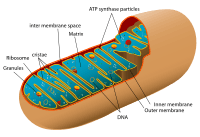
Mitochondrion
Click image to enlarge it
Ribosome
Assembled as subunits of rRNA/protein in nucleolus
Attach to mRNA strands (containing a gene) to guide assembly of amino acids into a polypeptide or protein
Amino acids are brought to the ribosome by tRNA
| Selected examples of important nucleic acids | |
|---|---|
| rRNA,ribosomal RNA | Forms ribosomes |
| mRNA messenger RNA |
Unfolded strand contains gene (code for one polypeptide) |
| tRNA transfer RNA |
Brings specific amino acids to ribosome and places them according to code on mRNA |
| nuclear DNA | “Master” genetic code in the nucleus |
| mDNA or mtDNA mitochondrial DNA |
Additional “master” genetic code in the mitochondrion |
Endoplasmic reticulum (ER)
Network of membranous canals and sacs
- ER extends outward from the outer boundary of the nucleus
Rough ER (RER) has temporarily-attached ribosomes
- Receives and processes polypeptides/proteins dropped off by ribosomes
- Also called granular ER
Smooth ER (SER) has no ribosomes
- Also processes proteins and is site of enzyme action, including manufacture of membrane components (thus, it makes “new” membrane for the cell)
- Transports calcium ions (Ca++) into ER sacs, removing it from the cytosol (discussed later in course)
- Also called agranular or nongranular ER
Golgi apparatus
Also called Golgi body or Golgi complex (named for Camillo Golgi)
Also called dictyosome (this is the official name in human anatomy)
Stack of separate, flattened sacs
- Sacs made of membrane are often called cisternae (sing. cisterna)
Processes, sorts, packages proteins sent by ER

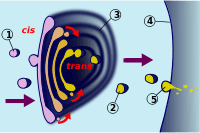
Golgi apparatus
click image to enlarge and see labels
Vesicles
Vesicle literally means “little vessels”
- Fluid-filled “bubbles” of membrane
- There are MANY types of vesicles in a cell
Examples
- Transport vesicles (such as ER or Golgi vesicles)
- Secretory vesicles
- Lysosomes contain lysing (digesting) enzymes
- Peroxisomes (bud from the ER) have enzymes that process H2O2 as they digest fats and detoxify poisons
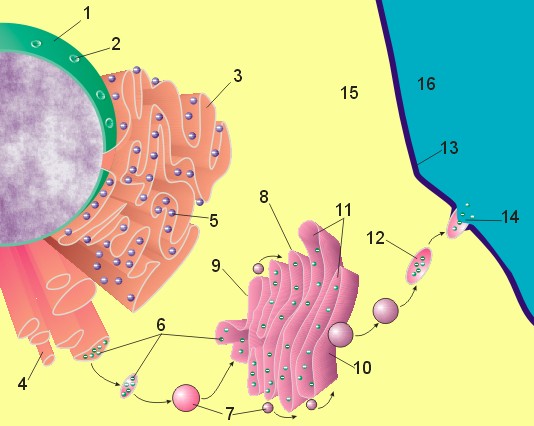
Formation of secretory vesicles
This diagram illustrates the process by which . . .
A. Proteins made by ribosomes enter the ER and are processed, then moved in ER vesicles to the Golgi apparatus.
B. Golgi vesicles then shuttle the chemicals from one sac (cisterna) to the next, as the Golgi apparatus further processes the chemicals.
C. Finished chemicals are packaged in vesicles that then may be secreted from the cell.
Some ER and Golgi vesicles instead remain in the cell and the chemicals inside perform intracellular functions.
| 1.Nuclear membrane | 7.Transport vesicles | 12.Secretory vesicle |
| 2.Nuclear pore | 8.Golgi apparatus | 13.Cell membrane |
| 3.Rough endoplasmic reticulum (RER) | 9.Cis (inner) face of Golgi apparatus | 14.Secretory vesicle fused to plasma membrane & releasing contents from cell |
| 4.Smooth endoplasmic reticulum | 10.Trans (outer) face of Golgi apparatus | 15.Cell cytoplasm |
| 5.Ribosome attached to REM | 11.Cisternae of Golgi apparatus | 16.Extracellular environment |
| 6.Macromolecules |
Proteasome
Hollow, drumlike cylinder made up of protein subunits 
Found throughout cytoplasm
Breaks apart abnormal / misfolded proteins or proteins that are no longer needed
- Small proteins called ubiquitins tag proteins for destruction by proteasomes
- Breaks proteins into small segments, which are later broken apart to individual amino acids (which in turn are recycled)
- Failure to dispose of misfolded proteins could result in buildup of harmful plaques
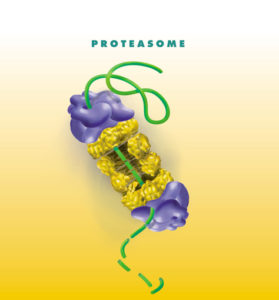
Proteasome
A protein (green) is shown moving from top to bottom through the hollow proteasome. Middle part is cut away to see where active enzymes cut the protein into small segments, which then move out ofthe bottom end.
(click image to enlarge)
Cytoskeleton
Made up of 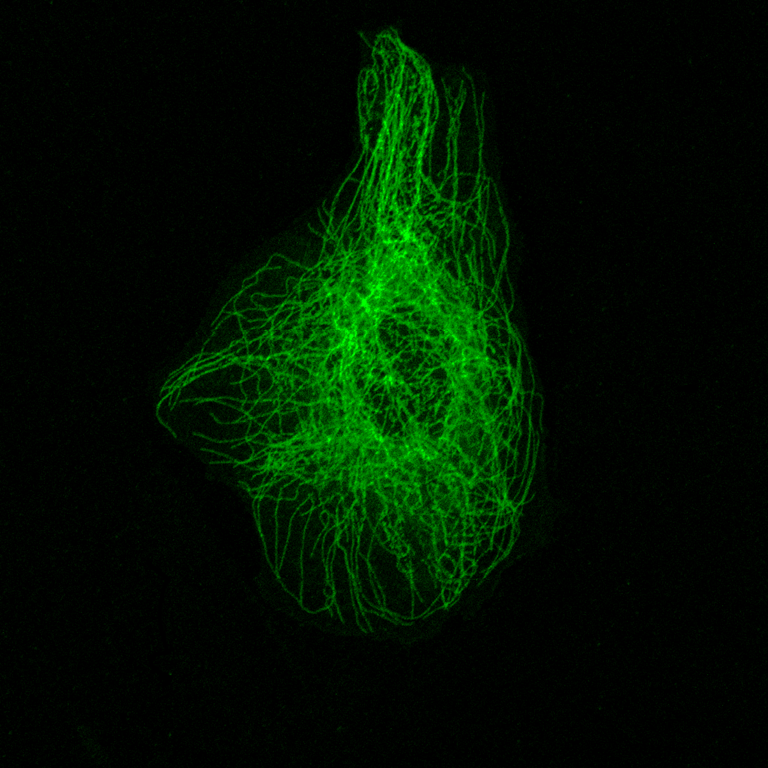
- Microfilaments
- Intermediate filaments
- Microtubules
- Adsorption of water on proteins and cross-linking of proteins gives cytoplasm a gel consistency

Functions include
- Support
- Movements of a cell
- Movement within a cell
- Forming/supporting a cell’s shape
- Anchoring/forming connections with other cells (see below)
Centrosome
- Also called microtubule-organizing center (MTOC)
- Guides formation and elongation of microtubules, as in mitosis
- Includes two cylindrical centrioles

Molecular motors
- Help to move materials or organelles within cell
- Provide power to move the cytoskeleton (and thus move or change the shape of cells
- Examples: dynein, myosin, kinesin
Cell extensions
- Microvilli (sing. microvillus)
- Increase surface area for absorption
- Cilia (sing. cilium)
- Groups of moving cilia move fluids along the surface of a sheet of cells
- Primary cilium
- Most cells have one or more (blood cells do not)
- Some have a sensory function (taste, smell, movement, etc)
- Involved in replication of centrioles
- Groups of moving cilia move fluids along the surface of a sheet of cells
- Flagella (sing. flagellum)
- Only the sperm cell has one
- Molecular motors at base allow flagellem to move, thus enabling swimming of sperm


Extracellular matrix (ECM)
Material outside of cells 
The ECM is a complex arrangement of fibers and other molecules that interact with cells to perform body functions
See the discussion at the beginning of Chapter 5 of Anatomy & Physiology textbook
Cell connections
Cells must be held together in a multicellular organism, or the tissues would simply fall apart
In some tissues, cells are held together by fibrous “nets” that are not part of the cells themselves
In some tissues, cells form junctions with each other

Desmosome
- Spot desmosomes: small patches of filaments from adjoining cells “tangle” together like Velcro patches, holding cells together (example: skin cells)
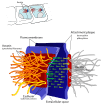
- Belt desmosomes: connecting band (rather than small patch) encircling the cell and connecting it to nearby cells
Tight junction
- Bands of protein units in adjoining cells “snap together” to form a tight seal all the way around one “end” of a cell, forming a sort of “collar” that sticks to the collars of nearby cells and thus forms a seal to prevent molecules from passing by a membrane made of cells held together by tight junctions (example: lining of intestines)

Tight junction
click to enlarge
Group junction 
- Protein units form channels that link together to form “tunnels” that lead from one cell to the next
- This arrangement not only joins cells structurally but also functionally, because molecules can move back and forth through gaps and the plasma membrane of each cell is now a continuous sheet—as if it’s now one giant cell (example: heart muscle cells)

Gap junction
click to enlarge
Cell Life Cycle
Life Cycles
All organisms have “life cycles” of development and reproduction—so do cells
- Parent (mother) cell divides to produce two genetically identical daughter cells
- Daughter cells may not be the same size or have exactly equal number of organelles
Phases
Cell cycle includes many phases of growth and development
Interphase (in-between phase)
- Phase during which cell is not actively dividing
- G1 phase (first growth [gap] phase) – new daughter cell is growing
- S phase (synthesis phase) – cell prepares for eventual cell division by replicating nuclear DNA
- So that there are now two identical sets (so that each daughter cell will receive one complete, identical set)
- Each DNA molecule splits (unzips) and new, complementary nucleotides fill in the missing side
- Each daughter DNA molecule (chromatid) is held together at the centromere
- G2 phase (second growth [gap] phase) – cell continues to grow, often “stockpiling” extra cytoplasm for an eventual split
- Centrioles (in the centrosome) are replicated during interphase
Mitosis
- Coordinated division of the nuclear DNA and equal distribution to each daughter cell
- Provides genetic integrity
- Also called nuclear division or M phase
- Phases of mitosis
- Prophase (preliminary phase)
- Nuclear envelope dissolves
- Chromatin (DNA) strands shorten into compact chromosomes (each chromosome is made up of two chromatids held together by a centromere)
- Each centriole moves toward an opposite pole of the cell, constructing a spindle of fibers (microtubules) across the cell


Prophase
- Prophase (preliminary phase)

- Metaphase (positioning phase) – chromosomes align at equator of cell and attach to spindle fibers

Metaphase
- Anaphase (separation phase) – spindle fibers pull toward poles, separating the chromatids to form individual chromosomes moving away from their sisters
Anaphase
- Telophase (end phase) – everything goes back to the way it “should be”—the chromosomes unwind to chromatin, the nuclear envelope reforms, the spindle is dismantled
Telephase
- Cytokinesis – the “pinching in” of the membrane and eventual separation of the two daughter cells; not as precise as nuclear division (mitosis); overlaps the end of mitosis
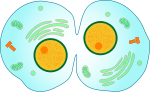
Cytoknesis
Daughter cells are now separate and in G1 of interphase
Chromosome numbers
Diploid number = 46 (for humans)
Haploid number = 23 (1/2 of diploid number)
Daughter cells should always have the diploid number of chromosomes—except egg cells and sperm cells, which should have the haploid number.
This is a Learning Outline page.
Did you notice the EXTRA menu bar at the top of each Learning Outline page with extra helps?
Last updated: October 23, 2019 at 0:13 am